Great Western Trail rules
eggertspiele · 2016
- Players
- 2–4
- Minutes
- 75–150
- Age
- 12+
Ask your question: I answer about this game’s rules.
The game in 30 seconds
You are a 19th-century rancher driving cattle from Texas to Kansas City, where they leave by train. Along the trail you stop at buildings to buy cattle, hire cowboys, craftsmen and engineers, build your own buildings and push your engine up the railroad. The more varied and valuable your hand on arrival, the farther you can ship.
A turn, in short
- Move your cattleman forward along the trail, up to your step limit, paying for every green or black hand you pass or reach.
- On a neutral building or one of yours, use its local actions or a single auxiliary action. Anywhere else, only a single auxiliary action.
- In Kansas City: pick three foresight tiles, collect income from your hand, then deliver to a city and pay transport costs.
- Draw cards until your hand is back at your hand limit.
How to win
- Most victory pointsAfter the final turns, score money, buildings, cities, stations, hazards, cattle, objectives, station masters and workers. Highest total wins; ties share the victory. (p. 16)
Printable play aids
3 free A5 play aids for Great Western Trail, from the rulebook: step-by-step setup, a player aid for everyone, and the turn sequence.
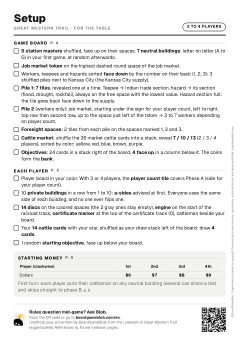 Setup
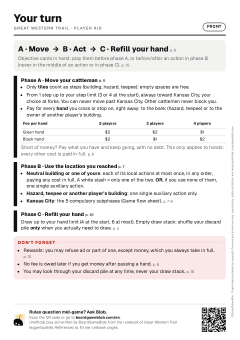 Player aid
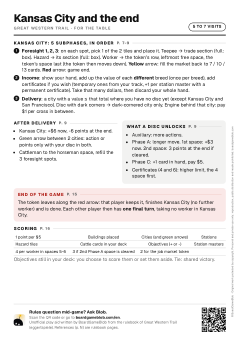 Game flow
The rules in questions
From the official rulebook by eggertspiele. In parentheses: the rulebook’s page. How Blob answers
How much money does each player start with in Great Western Trail?
The first player starts with 6 Dollars, and each following player clockwise gets one Dollar more: 7, then 8, then 9. Everyone also draws 4 cards from their shuffled herd deck. (p. 5)
What happens if I can't pay for a green or black hand?
You still move. Hand out whatever money you have left and keep going; you never owe the rest later. This leniency covers hand fees only, every other cost must be paid in full. (p. 6)
Do empty spaces on the trail count as steps?
No. Only tiles on the trail (buildings, hazards, teepees) and Kansas City are locations, and each location you pass or reach costs one step. Bare spaces are skipped freely. (p. 6)
What can I do when I stop on another player's building?
Only a single auxiliary action. The same goes for hazard and teepee tiles; local actions are available solely on neutral buildings and on buildings of your own color. (p. 7)
How is income calculated in Kansas City?
Add the breeding value of each different cattle type in your hand, counting duplicates of a type only once. You may raise the total with temporary certificates from your track plus any permanent ones, then take that many Dollars. (p. 8)
Can I deliver to the same city twice?
Not usually: a city already holding one of your discs is off limits. Kansas City and San Francisco are the exceptions and can receive your discs again and again. (p. 9)
How do transport costs work when delivering cattle, and when are they zero?
They depend on your engine. If its nose is level with or beyond the chosen city's crest, you pay nothing. If it lags behind, pay 1 Dollar per cross between the engine's nose and that city's value. (p. 9)
If both disc spaces of an auxiliary action are cleared, can I use the double version when I stop on an opponent's building?
No. The single auxiliary action you take instead of local actions can never be doubled. Doubling works only through the action icon that lets you choose a single or a double auxiliary action. (p. 13)
When does Great Western Trail end, and does everyone get another turn?
The end is triggered when a worker fills the last job market space during a Kansas City foresight step. That player finishes her turn, then every other player takes exactly one final turn before scoring. (p. 15)
Do I have to play objective cards from my hand?
No. Cards still in your deck at the end can be scored or dropped as you prefer. Cards already placed in your personal objective area must be scored, losing their negative value if unfulfilled. (p. 15, 16)
Common mistakes
- Adding an auxiliary action to local actionsIt is one or the other: the single auxiliary action is allowed only if you performed none of the location's local actions. (p. 7)
- Counting empty trail spaces as stepsOnly tiles placed on the trail are locations. A space with no tile costs no step and does not slow you. (p. 6)
- Hiring from the job market token's rowWorkers in the row holding the token are unavailable until it moves on to the next row. (p. 11)
- Counting duplicate cattle types for incomeEach type counts once, so two Dutch Belts add 2, not 4, to your total breeding value. (p. 8)
What’s in the rulebook
See the other part
Tap a part and Blob explains it.
Expansions
The game
- Players
- 2–4
- Length
- 75–150 min
- Age
- 12+
- Released
- 2016
- Designer
- Alexander Pfister
- Publisher
- eggertspiele
- Expansions
- 1
- Rules
- Official rulebook