Great Western Trail: Second Edition rules
eggertspiele · 2021
- Players
- 1–4
- Minutes
- 75–150
- Age
- 12+
Ask your question: I answer about this game’s rules.
The game in 30 seconds
You drive your herd across the West to Kansas City and ship it by train to a city in the East. Along the trail you stop at buildings to hire workers, buy cattle, construct your own buildings and advance your engine. The cattle in your hand decide how much each delivery earns. The game ends once the job market fills up, and the highest score wins.
A turn, in short
- Move your herder at least one location toward Kansas City, within your step limit, paying for any green and black hands you pass.
- On a neutral building or your own, use its local actions. Anywhere else, settle for one single auxiliary action.
- In Kansas City, go through the 5 subphases: three foresights, your income, then delivering your cattle to a city.
- Finish by drawing back up to your hand limit.
How to win
- Most pointsAfter everyone's final turn, total the 11 scoring pad categories. The highest score wins. (p. 18)
- TieTied players share the victory. (p. 18)
Printable play aids
4 free A5 play aids for Great Western Trail: Second Edition, from the rulebook: step-by-step setup, a player aid for everyone, the turn sequence, and a quick reference.
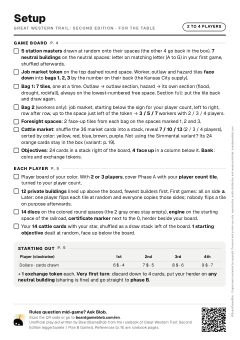 Setup
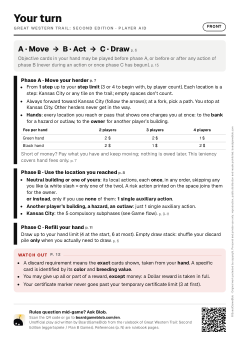 Player aid
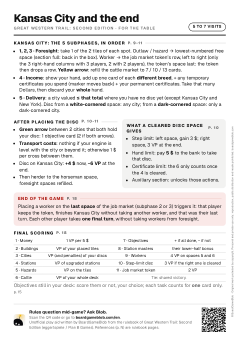 Game flow
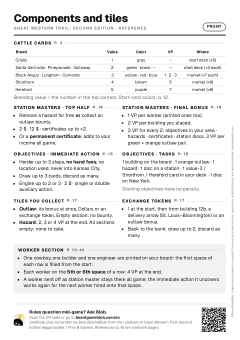 Reference
The rules in questions
From the official rulebook by eggertspiele. In parentheses: the rulebook’s page. How Blob answers
How much money and how many cards does each player start with in Great Western Trail Second Edition?
It depends on turn order: the first player gets 6 Dollars and 4 cards, the second 7 and 5, the third 8 and 6, the fourth 9 and 7, plus one exchange token each. On your very first turn you discard down to 4 cards. (p. 5)
What happens if I can't pay the fee for a green or black hand?
You still move on: pay whatever you can and keep going, and you never owe the rest later. This leniency only covers hand fees; every other cost in the game must be paid in full. (p. 7)
What can I do when my herder stops on another player's building?
Only one single auxiliary action. Local actions are available only on neutral buildings and on your own buildings, and the same single auxiliary action is all you get on hazard and outlaw tiles. (p. 8)
Can I use local actions and an auxiliary action on the same building?
No. On a neutral building or one of yours, you either use its local actions or one single auxiliary action. The auxiliary action is allowed only if you skip every local action of that tile. (p. 8)
How is my income calculated in Kansas City?
Add up the breeding value of each different cattle type in your hand, counting duplicates once. You may then add certificates, take that many Dollars from the bank, and discard your whole hand. (p. 10)
Can I deliver to the same city twice?
Normally no: a city that already holds one of your discs is off limits. Kansas City and New York are the exceptions and can receive your discs again. Delivering to Kansas City pays 4 Dollars now but costs 6 points at the end. (p. 10)
Which workers can I hire from the job market?
Any worker except those in the row holding the job market token. The price is shown at the right of the worker's row, adjusted by the modifier on the hiring icon you used. A full row in your worker section blocks further hires of that type. (p. 13)
When am I allowed to play an objective card from my hand during my turn?
Before phase A, or before or after any single action in phase B. You can't play one in the middle of an action or once phase C has begun. The card goes to your objective area and you may use its immediate action. (p. 15)
How does the game end in Great Western Trail Second Edition, and who gets the last turns?
It ends when a worker fills the last job market space in Kansas City, pushing the job market token off the market. That player finishes the turn, every other player takes one last turn, then the final scoring follows. (p. 18)
Do I have to score objective cards that are still in my deck?
No. At the end, for each objective card left in your deck you choose to discard it or add it to your objective area. Cards already in your objective area must be scored, even if they cost you points. (p. 15, p. 18)
Common mistakes
- Adding an auxiliary action to local actionsIt is one or the other: the single auxiliary action is only allowed if you give up all of the tile's local actions. (p. 8)
- Hiring from the job market token's rowWorkers in the row where the job market token sits are not available yet. Hire from a row the token has already left. (p. 13)
- Counting duplicate cattle types for incomeEach cattle type in your hand counts only once toward your total breeding value, however many copies you hold. (p. 10)
- Putting any disc on any cityA disc taken from a dark-cornered space can only go onto a city or station space that also has dark corners. White-cornered discs go anywhere. (p. 10)
What’s in the rulebook
See the 6 other parts
Tap a part and Blob explains it.
Expansions
The game
- Players
- 1–4
- Length
- 75–150 min
- Age
- 12+
- Released
- 2021
- Designer
- Alexander Pfister
- Publisher
- eggertspiele
- Expansions
- 1
- Rules
- Official rulebook