Le Havre rules
Lookout Games · 2008
- Players
- 1–5
- Minutes
- 30–150
- Age
- 12+
Ask your question: I answer about this game’s rules.
The game in 30 seconds
You run a business in the harbor: collect goods from the Offer spaces, upgrade them in buildings, and construct your own buildings and ships. Every seven turns a round ends with a Harvest and you must feed your workers. After the last round and one final action, the largest fortune wins.
A turn, in short
- Move your Ship marker to the next Supply tile and add its two tokens to the matching Offer spaces.
- Main action: take everything from one Offer space, or enter a free building and pay its entry fee.
- Whenever you like during your turn, buy buildings or ships. Selling to the town is allowed even on other turns.
How to win
- Largest fortuneAdd up your buildings and ships, their plus-symbol bonuses and your cash, then subtract 7 Francs for each loan still held. (p. 9)
- TieEvery player sharing the top total is a winner. (p. 9)
Printable play aids
3 free A5 play aids for Le Havre, from the rulebook: step-by-step setup, a player aid for everyone, and the turn sequence.
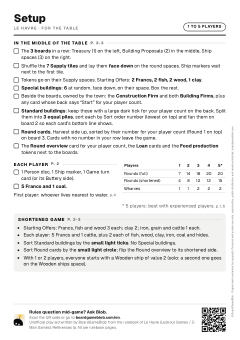 Setup
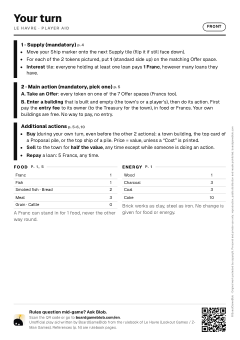 Player aid
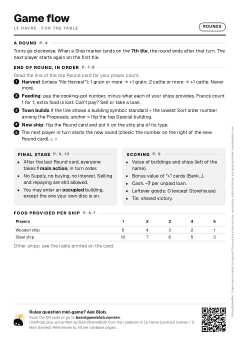 Game flow
The rules in questions
From the official rulebook by Lookout Games. In parentheses: the rulebook’s page. How Blob answers
How many rounds is a game of Le Havre?
It depends on player count: the full game lasts 7 rounds solo, 14 with two, 18 with three and 20 with four or five. The shortened version uses 4, 8, 12, 12 and 15 rounds. (p. 1)
What does each player start with in Le Havre?
In the full game, everyone gets 5 Francs and 1 coal, and the Offer spaces begin with 2 Francs, 2 fish, 2 wood plus 1 clay. The shortened game gives a much bigger starting supply. (p. 2)
Can you pay food with Francs?
Yes: each Franc counts as 1 food, both for entry fees and for the Feeding phase. It never works the other way, so food cannot stand in for money. (p. 5, p. 8)
How does the Harvest work?
If you hold at least 1 grain you gain 1 more grain, and if you hold at least 2 cattle you gain 1 more cattle. You never get more than one of each, and rounds marked no Harvest give nothing. (p. 7)
When are you allowed to take a loan?
Only when you cannot pay interest or the food owed at the end of a round, after spending all your food and money. Each loan gives 4 Francs, repaying costs 5, and an unpaid loan costs 7 Francs at the end. (p. 10)
Do you pay an entry fee to use your own building?
No, your own buildings are free to enter. Another player's building costs its fee paid to that player, and a town building's fee goes to the Treasury. (p. 5)
Can I buy a building and use it in the same turn?
Yes. Buying is an additional action you may take at any moment of your own turn, so you can purchase a building and then enter it with your Main action, like the Marketplace example in the rules. (p. 5, p. 9)
What is the difference between building and buying a building or ship in Le Havre?
Building uses your Main action at a construction building and costs materials; buying is an additional action paid in money. Only the top cards of the Building Proposals can be built, while town-owned buildings can only be bought. (p. 9)
What happens during the final action, and can I use an occupied building then?
After the last round, each player takes one more Main action, with no supply or buying. In this stage only, you may enter a building even if other discs are on it, except the one your own disc already occupies. (p. 9)
How do you round halves, for example when a building gives half a Franc per good?
Always against the player: anything you receive is rounded down and anything you pay is rounded up. Selling buildings or ships never needs rounding because their values are even. (p. 10)
Common mistakes
- Taking change after paying with foodOverpaying in Francs gets you change, but extra food or energy you hand over is simply lost. (p. 10)
- Staying on a building to use it againA building only acts when you enter it. To use it again you must move away and come back later. (p. 5)
- Forgetting ships for the Feeding phaseEach ship you own lowers the food you pay at the end of every round; without ships, finding food can eat up your game. (p. 7)
- Rounding halves in your favorRounding always goes against the player: receive rounded down, pay rounded up. (p. 10)
What’s in the rulebook
See the 5 other parts
Tap a part and Blob explains it.
Expansions
The game
- Players
- 1–5
- Length
- 30–150 min
- Age
- 12+
- Released
- 2008
- Designer
- Uwe Rosenberg
- Publisher
- Lookout Games
- Expansions
- 3
- Rules
- Official rulebook