Ora et Labora rules
Lookout Games · 2011
- Players
- 1–4
- Minutes
- 60–180
- Age
- 13+
Ask your question: I answer about this game’s rules.
The game in 30 seconds
You run a medieval monastery. Send your prior and two lay brothers to buildings to produce goods, refine them and pay for new construction on your growing landscape. A production wheel makes goods pile up each round, and settlement phases let you found villages next to valuable buildings. After the bonus round and the final settlement phase, the highest score wins.
A turn, in short
- If all three of your clergymen are placed, take them all back. Then rotate the production wheel one space counterclockwise.
- If the beam passes the next card pile, play a settlement phase before any actions.
- In clockwise order, each player takes one action: place a clergyman, fell trees or cut peat, or build a building.
- The starting player takes a second action, then passes the starting player marker to the left.
How to win
- Most pointsAdd up the points on your goods tiles, the economic value of your cards and your settlement scores. The highest total wins; ties share the victory. (p. 7)
- SoloPlaying alone, your goal is to reach 500 points. (p. 8)
Printable play aids
3 free A5 play aids for Ora et Labora, from the rulebook: step-by-step setup, a player aid for everyone, and the turn sequence.
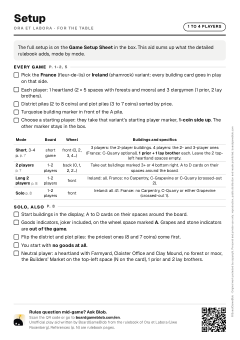 Setup
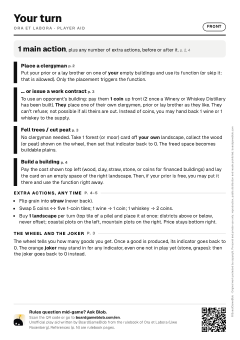 Player aid
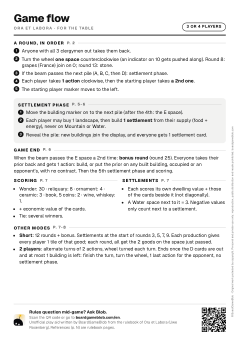 Game flow
The rules in questions
From the official rulebook by Lookout Games. In parentheses: the rulebook’s page. How Blob answers
When do you get your clergymen back in Ora et Labora?
Only at the start of a round, and only if all three of your clergymen are sitting on buildings; then you must take them all back. If just one or two are placed, they stay where they are. (p. 2)
How much does a work contract cost, and can the owner refuse?
It costs 1 coin, paid to the owner right away, rising to 2 coins for everyone once a Winery or Whiskey Distillery exists. The owner cannot refuse and picks which of their available clergymen to place. (p. 3)
Can I pay for a work contract with wine or whiskey?
Yes. Instead of coins, you can return 1 wine (France) or 1 whiskey (Ireland) to the general supply. In that case the building's owner receives nothing at all. (p. 3)
How does the joker work on the production wheel?
Whenever an action uses the production wheel, you may take the amount shown by the joker instead of the normal indicator; the joker then returns to 0 and the regular indicator stays put. It even works for stone or grapes before their own indicators arrive. (p. 3)
Does felling trees or cutting peat need a clergyman?
No. Removing a forest or moor card is its own action and uses no clergyman, but only on your own landscape. The freed space becomes buildable Plains. (p. 3, p. 4)
Can I place my prior on a building the same turn I build it?
Yes, but only your prior, and only if it is still available: after building, you may put the prior on the new building and use its function immediately. Lay brothers cannot do this. (p. 4)
Where can cloister buildings be placed, and what can go on mountain or water spaces?
Cloister buildings, marked by a yellow title banner, must touch another cloister building horizontally or vertically. Mountain spaces only accept Quarries or the Castle, and water spaces only the Houseboat, which exists in the Ireland variant. (p. 4)
How does the bonus round work in a three or four player game?
Everyone takes their prior back and gets exactly one action: build, or place the prior on any built building, even an occupied one or an opponent's, without paying a work contract. A final settlement phase follows, then scoring. (p. 6)
How are settlements scored at the end of the game?
Each settlement scores its own dwelling value plus those of all orthogonally adjacent cards; diagonals don't count. Adjacent water spaces add 3, and negative values only matter next to a settlement. A building next to two settlements counts for both. (p. 7)
When does the two player game end?
There is no fixed end: once the D buildings are out and at most one building remains in the display, finish the current turn, rotate the wheel, and the other player takes one final action. There is no bonus round and no final settlement phase. (p. 8)
Common mistakes
- Leaving the indicator in place after producingAs soon as a type of goods is produced, its indicator goes back to space 0 on the wheel, so that good takes a few rounds to build up again. (p. 3)
- Building a settlement with the Build actionSettlements are only placed during settlement phases, at most one per player, by paying their food and energy cost. The Build a building action cannot be used for them. (p. 6)
- Using a new building with a lay brother right awayRight after building, only your prior can go straight onto the new building, and only if it is still available. (p. 4)
- Forgetting that grain can become straw any timeYou may flip grain into straw at any moment, even mid-payment, but straw never turns back into grain. (p. 4)
What’s in the rulebook
See the 6 other parts
Tap a part and Blob explains it.
The game
- Players
- 1–4
- Length
- 60–180 min
- Age
- 13+
- Released
- 2011
- Designer
- Uwe Rosenberg
- Publisher
- Lookout Games
- Rules
- Official rulebook