My City rules
KOSMOS · 2020
- Players
- 2–4
- Minutes
- 30
- Age
- 10+
Ask your question: I answer about this game’s rules.
The game in 30 seconds
A legacy game in which each player builds a city on their own board over 24 episodes grouped into chapters. Every round, a card names the building that everyone places at the same time. At the end of an episode, visible trees score while rocks and empty spaces cost points. The best players color in progress symbols, and the total decides the campaign winner.
A turn, in short
- Turn over the top construction card of the deck.
- Everyone takes the matching building and places it on their own board right away, all at the same time.
- If you cannot or will not place it, pass for a one-point loss or end your participation in the episode at no cost.
How to win
- Legacy campaignAfter each episode, the top scorers color in progress symbols. Whoever has the most of them after all 24 episodes wins. (p. 3)
- Eternal GameOn the back of the boards, each game stands alone and the highest score wins. (p. 7)
Printable play aids
3 free A5 play aids for My City, from the rulebook: step-by-step setup, a player aid for everyone, and the turn sequence.
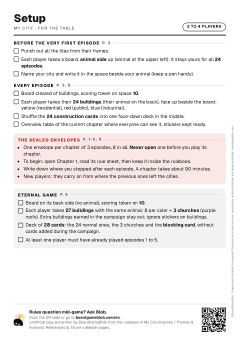 Setup
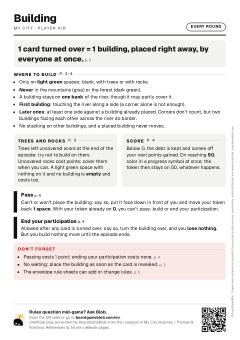 Player aid
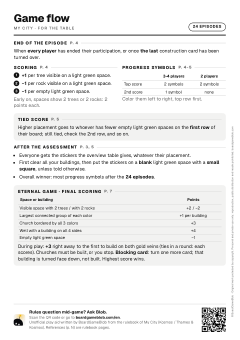 Game flow
The rules in questions
From the official rulebook by KOSMOS. In parentheses: the rulebook’s page. How Blob answers
How do you win a My City campaign?
The player with the most colored-in progress symbols after all 24 episodes wins. In each episode, the top scorers earn progress symbols: two for first place and one for second place with three or four players. (p. 3)
Where does your first building have to go?
Your first building must run along the river with a full side, since touching it with just a corner does not count. Every later building needs to share at least one side with a building you have already placed. (p. 3-4)
Do two buildings on opposite banks of the river count as adjacent?
Yes, buildings separated only by the river still count as bordering each other. A single building, however, may never straddle the river with parts on both banks, although it may partly cover it while staying on one side. (p. 3-4)
What is the difference between passing and ending your participation in an episode?
Passing costs you one point but keeps you in the episode for later cards. Ending your participation costs nothing, but you place no more buildings for the rest of that episode. If your token is already on zero, you cannot pass and must drop out instead. (p. 4)
How is an episode scored at the end?
Each tree still visible on a light green space earns one point, while each visible rock and each uncovered light green space costs one point. These are added to your track total, which started the episode at 10. (p. 4)
What happens if my score goes below zero or reaches 50?
Points below zero are not forgotten: they are taken off the next positive points you earn. At 50, you immediately color in one progress symbol and your token stays at 50 whatever else you gain or lose. (p. 4)
How are ties broken at the end of an episode?
Among tied players, whoever has fewer uncovered light green spaces in their board's top row ranks higher. If that row is also equal, compare the second row, then the next, and so on. The Eternal Game uses the same tiebreaker. (p. 5, 7)
What changes in a two-player game of My City?
With two players, only the top scorer earns progress symbols, coloring in two of them. The runner-up gets none, whereas with three or four players the second place colors in one. (p. 4)
Can you play the Eternal Game with friends who have not played the legacy campaign?
Yes, the Eternal Game boards are all identical, so newcomers can join in. At least one person at the table must already have played episodes one through five of the legacy game. (p. 6)
How do churches and wells score in the Eternal Game?
A church gives three extra points when buildings of all three colors sit along three of its sides. A well gives four extra points when a building borders it on each of its four sides. Churches must always be built when their card comes up. (p. 7)
Common mistakes
- Thinking rocks cannot be built onLight green spaces with rocks or trees can both take buildings. Covering rocks is actually wise, since any left visible cost you points. (p. 3)
- Building on mountains or forestGray and dark green spaces are off limits. Only light green spaces can hold buildings. (p. 3)
- Taking your time before placingThe building goes down as soon as its card is revealed, with no waiting, and all players build simultaneously. (p. 3)
What’s in the rulebook
See the other part
Tap a part and Blob explains it.
The game
- Players
- 2–4
- Length
- 30 min
- Age
- 10+
- Released
- 2020
- Designer
- Reiner Knizia
- Publisher
- KOSMOS
- Rules
- Official rulebook