Tigris & Euphrates rules
Hans im Glück · 1997
- Players
- 2–4
- Minutes
- 60–120
- Age
- 14+
Ask your question: I answer about this game’s rules.
The game in 30 seconds
Each player leads a dynasty of four leaders and places tiles to grow kingdoms between the two rivers. You collect victory points in four colors by placing tiles, winning revolts and wars, building monuments and grabbing treasures. At the end only your weakest color counts, so you must develop all four.
A turn, in short
- Take two actions, possibly the same one twice.
- Choose from: position a leader, place a civilization tile, play a catastrophe tile, or swap up to six tiles.
- Resolve any conflict, monument or treasure triggered by an action before it ends.
- At the end of your turn, score your monuments, then draw back up to six tiles.
How to win
- Weakest colorEveryone counts their lowest color, using treasures as wild points. The highest total wins; ties go to the second-lowest color, and so on. (p. 14)
Printable play aids
3 free A5 play aids for Tigris & Euphrates, from the rulebook: step-by-step setup, a player aid for everyone, and the turn sequence.
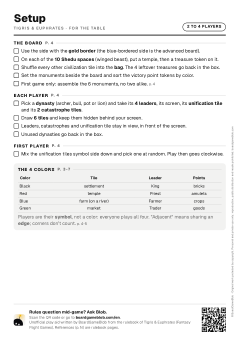 Setup
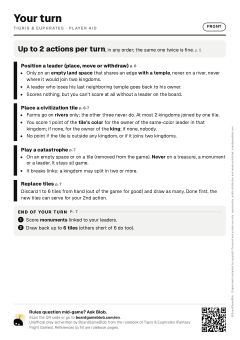 Player aid
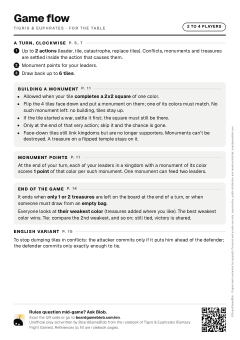 Game flow
The rules in questions
From the official rulebook by Hans im Glück. In parentheses: the rulebook’s page. How Blob answers
How many actions do you get per turn in Tigris & Euphrates?
You take up to two actions, in any order, and you may take the same one twice. The options are positioning a leader, placing a tile, playing a catastrophe tile, or swapping up to six tiles from your hand. (p. 5)
How does the game end?
The game ends when only one or two treasures are left on the board at the end of a turn, or when someone has to draw a tile and the bag is empty. (p. 14)
How do you win, and how are ties broken?
The winner is the player whose weakest color has the most victory points, with treasures assigned freely as wild points. If tied, compare second-lowest colors, and so on; players equal in all four share the win. (p. 14)
Who wins a tie in a revolt or a war?
The defender wins any tie. In both kinds of conflict, the attacker commits extra tiles first, then the defender, and each may commit only once. (p. 8-9)
What is the difference between a revolt and a war?
A revolt happens when you place a leader into a kingdom that already has a leader of that color, and it is fought with adjacent temples. A war happens when a tile joins two kingdoms holding same-colored leaders, and it is fought with matching tiles in each leader's part of the kingdom. (p. 7-9)
Who scores a point when I place a tile in a kingdom with no leader of that color?
The owner of the king in that kingdom scores it. If there is neither a matching leader nor a king, or the tile is not in a kingdom, nobody scores. (p. 7)
If I lose a war with my priest, do all my temples get removed?
No. Temples holding a treasure or touching a leader of another color stay on the board, and the winner earns no amulets for those temples. (p. 9-10)
Can a king score from a monument of any color?
No, a king only scores from a black monument. At the end of your turn, each of your leaders earns one point per monument of its own color in the same kingdom. (p. 11)
When does a trader collect treasures, and what are they worth?
When a kingdom holds two or more treasures after an action, its trader takes all but one, starting with special border spaces. Each treasure is a wild point you assign to any color at game end. (p. 12)
What happens to a leader when the temple next to it is destroyed or flipped?
If that was the last temple next to the leader, the leader goes back to its owner. This can be caused by a catastrophe tile, a monument flipping temples, or the wonder. (p. 6, 10)
Common mistakes
- Counting every temple in a revoltIn a revolt, only temples sharing an edge with each conflicting leader count, plus temples committed from hand. One temple can count for both sides. (p. 8)
- Letting the king score from any monumentThe king stands in for missing leaders when tiles are placed, but for monuments it only scores with a black one. (p. 11)
- Scoring the tile that joins two kingdomsThe joining tile never scores. It is covered by the unification tile while any wars are resolved, then uncovered. (p. 7-8, 11)
- Placing a catastrophe on a treasureA catastrophe tile can go on an empty space or cover a tile, but never on a leader, a monument, or a tile with a treasure. (p. 7)
What’s in the rulebook
See the 17 other parts
Tap a part and Blob explains it.
Expansions
The game
- Players
- 2–4
- Length
- 60–120 min
- Age
- 14+
- Released
- 1997
- Designer
- Reiner Knizia
- Publisher
- Hans im Glück
- Expansions
- 1
- Rules
- Official rulebook