Sushi Go! rules
Adventureland Games · 2013
- Players
- 2–5
- Minutes
- 15
- Age
- 8+
Ask your question: I answer about this game’s rules.
The game in 30 seconds
A quick card drafting game played over 3 rounds. Everyone keeps one card from their hand, then hands the rest to a neighbor. You collect sushi, maki rolls, tempura and dumplings to build scoring combinations. Points are counted after each round, and puddings only at the very end.
A turn, in short
- At the same time as everyone else, pick one card from your hand and lay it face-down in front of you.
- All players flip their chosen cards at once.
- Pass the rest of your hand to your left neighbor and pick up the hand you receive.
- When the last cards are placed, the round ends and everyone scores their table.
How to win
- Most pointsAfter three rounds and the pudding count, the highest score wins. On a tie, more puddings decides. (p. 5)
Printable play aids
3 free A5 play aids for Sushi Go!, from the rulebook: step-by-step setup, a player aid for everyone, and the turn sequence.
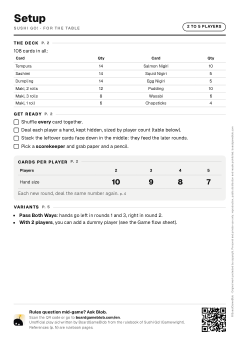 Setup
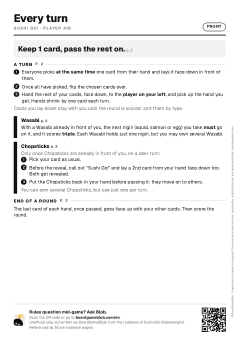 Player aid
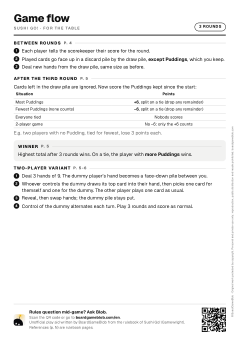 Game flow
The rules in questions
From the official rulebook by Adventureland Games. In parentheses: the rulebook’s page. How Blob answers
How many cards does each player get in Sushi Go?
It depends on player count: 10 cards each with 2 players, 9 with 3, 8 with 4 and 7 with 5. You deal the same number again at the start of each of the 3 rounds. (p. 2, 4)
How do chopsticks work in Sushi Go?
Chopsticks you already have on the table let you keep two cards in one later turn. Pick your first card, say Sushi Go! before the reveal, add a second card face-down, then return the chopsticks to your hand so they get passed on. (p. 3)
Does wasabi triple any card?
No, wasabi only triples a squid, salmon or egg nigiri taken after it, which must go on top of it. Each wasabi holds one nigiri, and an empty wasabi scores nothing. (p. 2, 4)
If two players tie for the most maki rolls, does anyone get the 3 points for second place?
No. Tied leaders share the 6 points, rounding down, and nobody receives second-place points. Players tied for second share the 3 points the same way. (p. 3)
How many points are tempura, sashimi and dumplings worth?
Each pair of tempura is worth 5 points and each trio of sashimi 10; incomplete sets give 0. Dumplings score 1, 3, 6, 10, then 15 for five or more. (p. 4)
When are pudding cards scored?
Puddings are scored only once, at the end of the game, so you keep them in front of you between rounds. Most puddings gains 6 points, fewest loses 6, with ties shared. (p. 4, 5)
In a 2-player game, does the player with fewer puddings lose 6 points?
No. With two players there is no pudding penalty; only the player with the most puddings scores the 6 points. (p. 5)
What happens if everyone has the same number of puddings at the end?
Nobody scores anything for puddings in that case, neither the bonus nor the penalty. (p. 5)
How is a tie broken at the end of Sushi Go?
The tied player holding more pudding cards wins. Otherwise the highest total after the three rounds wins. (p. 5)
How does the two-player variant with a dummy player work?
Deal three hands of 9; the third becomes a face-down dummy pile. The player in control draws its top card, then keeps one card and plays one for the dummy, and control switches every turn. (p. 5, 6)
Common mistakes
- Discarding puddings between roundsPuddings stay in front of you until the game ends; every other card you played goes to the discard pile. (p. 4)
- Keeping chopsticks after using themOnce used, the chopsticks go back into the hand you pass, so a neighbor can take them. Only one pair can be used per turn. (p. 3)
- Sliding wasabi under a nigiri already playedWasabi only boosts a nigiri you take later, placed on top of it. One nigiri per wasabi, and a lone wasabi is worth nothing. (p. 2, 4)
What’s in the rulebook
See the 2 other parts
Tap a part and Blob explains it.
The game
- Players
- 2–5
- Length
- 15 min
- Age
- 8+
- Released
- 2013
- Designer
- Phil Walker-Harding
- Publisher
- Adventureland Games
- Rules
- Official rulebook