Sushi Go Party! rules
Gamewright · 2016
- Players
- 2–8
- Minutes
- 20
- Age
- 8+
Ask your question: I answer about this game’s rules.
The game in 30 seconds
A card drafting game for 2 to 8 players around a sushi feast. Before playing, the group picks the menu: eight card types out of a wide selection. Each turn you keep one card from your hand and pass the rest to your left. After three rounds and dessert scoring, the highest total wins.
A turn, in short
- Everyone at once: pick one card from your hand and set it face-down in front of you.
- Reveal all chosen cards together and resolve any immediate effects or called-out bonus actions.
- Pass the rest of your hand face-down to the left, take the hand coming to you and repeat.
- When hands run out, the round ends: score everything except desserts, which you set aside until the end.
How to win
- Most pointsAfter the third round, desserts are scored too; the highest total wins. On a tie, whoever has more dessert cards wins. (p. 7)
Printable play aids
3 free A5 play aids for Sushi Go Party!, from the rulebook: step-by-step setup, a player aid for everyone, and the turn sequence.
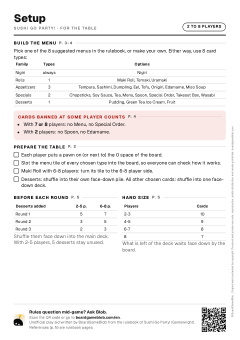 Setup
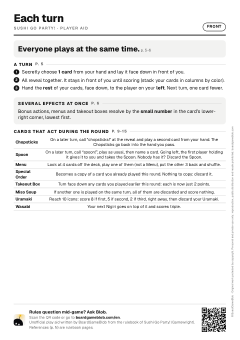 Player aid
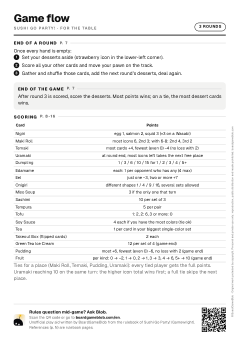 Game flow
The rules in questions
From the official rulebook by Gamewright. In parentheses: the rulebook’s page. How Blob answers
How many cards does each player get in Sushi Go Party?
It depends on the player count: 10 cards with 2 or 3 players, 9 with 4 or 5, 8 with 6 or 7, and 7 cards with 8 players. (p. 5)
How many dessert cards go into the deck each round?
With 2 to 5 players, add 5 desserts before round 1, then 3, then 2. With 6 to 8 players, add 7, then 5, then 3. The other desserts stay out. (p. 5)
Which cards can't be used with 2 players or with 7-8 players?
In a two-player game, leave out the spoon and edamame. With seven or eight players, menu and special order are not allowed. (p. 4)
How do you build your own menu in Sushi Go Party?
Always include nigiri, then pick one kind of rolls, three kinds of appetizers, two kinds of specials and one dessert, while respecting the player-count restrictions. (p. 4)
What happens if two players play miso soup on the same turn?
Every miso soup revealed that turn is discarded right away and scores nothing, even if both were yours. A soup gained with chopsticks, spoon, menu or special order counts as played that same turn. (p. 11)
How do chopsticks work?
They do nothing on the turn you play them. On a later turn, call them out during the reveal, play a second card from your hand, then put the chopsticks back into the hand you pass on. (p. 12)
Who wins a tie in Sushi Go Party?
After three rounds and dessert scoring, the tied player holding more dessert cards wins. (p. 7)
If two players reach 10 uramaki icons on the same turn, who gets first place?
The one with more uramaki icons in total takes the higher place. If they are still level, both get the full points for that place and the following place is not awarded. (p. 9)
Does soy sauce compare colors only between players who played soy sauce?
No. Everyone compares the number of different background colors among their played cards; a soy sauce scores 4 if its owner has the most or ties for the most. The soy sauce counts as a color, and only desserts from this round count. (p. 12)
Can a special order copy a nigiri and still go on my empty wasabi?
Yes. If the copied nigiri is not on a wasabi and you have a wasabi without a nigiri, the special order can be placed on it as that nigiri. Copying a nigiri already on a wasabi does not triple the copy. (p. 14)
Common mistakes
- Putting a nigiri beside an empty wasabiOnce you have a wasabi, your next nigiri must go on top of it. Only one nigiri fits on each wasabi. (p. 15)
- Collecting too much tofuOne or two tofu score points, but with three or more, all of your tofu are worth nothing. (p. 11)
- Forgetting that a single eel costs pointsA lone eel loses you 3 points; you need at least two to gain 7. (p. 10)
- Leaving desserts in the deck between roundsPlayed desserts stay beside you until the game ends, and fresh desserts are shuffled in before each new round. (p. 7)
What’s in the rulebook
See the 4 other parts
Tap a part and Blob explains it.
The game
- Players
- 2–8
- Length
- 20 min
- Age
- 8+
- Released
- 2016
- Designer
- Phil Walker-Harding
- Publisher
- Gamewright
- Rules
- Official rulebook