Blue Moon City rules
CMON Global Limited · 2006
- Players
- 2–4
- Minutes
- 30–50
- Age
- 14+
Ask your question: I answer about this game’s rules.
The game in 30 seconds
The peoples of Blue Moon are rebuilding their ruined city. You walk from tile to tile and spend People cards of the right color to claim spaces on buildings. Each finished building hands out crystals, cards or golden dragon scales. Crystals go to the Obelisk, and the first player to make enough Offerings wins at once.
A turn, in short
- Walk your figure up to two tiles orthogonally, or stay put; cards with movement powers can be used now.
- Pay one or more spaces on your building with cards of matching color and enough value, placing a marker on each.
- If you stand in the Courtyard, you may instead spend crystals for one Offering to the Obelisk.
- Optionally discard up to two cards, then draw two plus that number.
- Hand the turn to the player on your left.
How to win
- Offerings to the ObeliskReach 6 Offerings with 2 players, 5 with 3 or 4 with 4 to win right away. (p. 11)
- City fully rebuiltIf nobody can reach the target, the most Offerings wins; ties go to the most crystals left. (p. 11)
Printable play aids
4 free A5 play aids for Blue Moon City, from the rulebook: step-by-step setup, a player aid for everyone, the turn sequence, and what the expansions add.
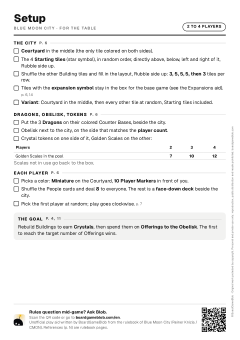 Setup
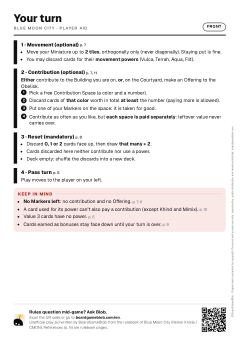 Player aid
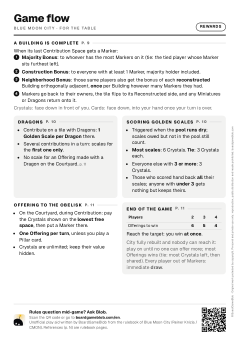 Game flow
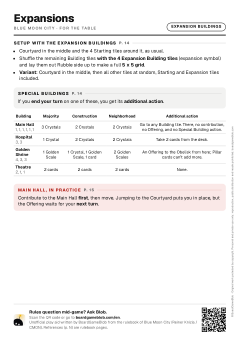 Expansions
The rules in questions
From the official rulebook by CMON Global Limited. In parentheses: the rulebook’s page. How Blob answers
How do you win Blue Moon City?
You win immediately once you have made enough Offerings to the Obelisk: 6 in a 2-player game, 5 with 3 players and 4 with 4 players. (p. 11)
How many spaces can you move in Blue Moon City?
Up to 2 tiles per turn, orthogonally only, never diagonally. Moving is optional, and a grey Flit card can extend or replace your move. (p. 7, 12)
Can I use leftover card value from one contribution for another in Blue Moon City?
No. Every contribution is paid separately, so excess value on one space is lost and the same cards cannot count twice. You may still make several contributions on one building in a turn. (p. 7)
Who gets the majority bonus when players are tied in Blue Moon City?
Among the tied players, the one whose marker sits furthest to the left on the building takes the majority bonus. Everyone who contributed still gets the construction bonus. (p. 9)
How are golden scales scored in Blue Moon City?
When the last scale leaves the pool, the leader gets 6 crystals (3 each if tied), others with at least 3 scales get 3 crystals. Those who score return their scales; players with fewer than 3 keep theirs. (p. 10)
Do I get a golden scale for each contribution made next to a dragon?
Only for your first contribution of the turn on that tile, though several dragons there each give you a scale. Offerings to the Obelisk never earn scales, even with a dragon in the Courtyard. (p. 10, 11)
Can I play a card for its special power and still use it to pay for a contribution in Blue Moon City?
Usually not: once discarded for its power, a card no longer counts toward a contribution. Green Khind and brown Mimix cards are the exceptions, because their powers are about contributing. (p. 7, 12)
When do cards earned from a completed building go into my hand?
Keep them facedown in front of you without looking, and take them into your hand only once your turn is over. (p. 9)
What happens in Blue Moon City if every building is rebuilt and nobody has made enough Offerings?
Keep playing until each player has made all the Offerings they can; the most Offerings wins, then most remaining crystals. If everyone runs out of markers first, the game ends in a draw. (p. 11)
How many cards do I draw at the end of my turn in Blue Moon City?
You may first discard up to 2 cards, then draw 2 plus the number discarded, so between 2 and 4 cards. This step is mandatory. (p. 8)
Common mistakes
- Using a card for its power and to payA card discarded for its special power can no longer help pay a contribution, except Khind and Mimix cards. (p. 12)
- Carrying spare value into another spaceEach space is paid on its own; any surplus value is wasted. (p. 7)
- Taking several scales per dragon each turnDragons reward only your first contribution of the turn, and Obelisk Offerings never earn scales. (p. 10, 11)
- Looking at earned cards right awayCards won from a building stay facedown in front of you until your turn ends. (p. 9)
What’s in the rulebook
See the 6 other parts
Tap a part and Blob explains it.
Expansions
The game
- Players
- 2–4
- Length
- 30–50 min
- Age
- 14+
- Released
- 2006
- Designer
- Reiner Knizia
- Publisher
- CMON Global Limited
- Expansions
- 1
- Rules
- Official rulebook