Lost Cities: Rivals rules
KOSMOS · 2018
- Players
- 2–4
- Minutes
- 40
- Age
- 10+
Ask your question: I answer about this game’s rules.
The game in 30 seconds
Two to four explorers compete for cards through gold-coin auctions. Cards you win build color expeditions whose values may never go down, with wagers at the front to multiply them. When the last card of the last pile is flipped, footprints, bonuses and remaining gold decide the winner.
A turn, in short
- Choose one action: flip the top draw pile card into the display, or open an auction with a bid of one coin or more.
- In an auction, each player clockwise raises or drops out for good.
- The winner pays into the supply, takes any display cards wanted, may box one, then flips a new card.
- The player after the winner gets the starting player card and takes the next turn.
How to win
- Most pointsFootprints times your wager multiplier, plus 8 for each expedition of four or more number cards, plus one point per coin. Highest total wins. (p. 6)
Printable play aids
3 free A5 play aids for Lost Cities: Rivals, from the rulebook: step-by-step setup, a player aid for everyone, and the turn sequence.
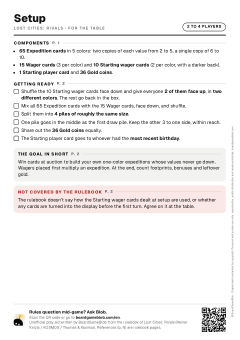 Setup
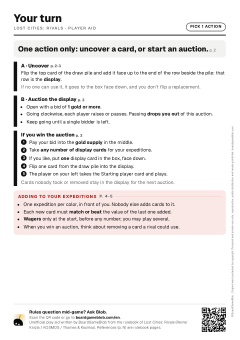 Player aid
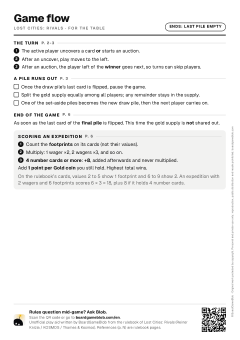 Game flow
The rules in questions
From the official rulebook by KOSMOS. In parentheses: the rulebook’s page. How Blob answers
How many gold coins does each player start with in Lost Cities: Rivals?
All 36 coins are split evenly among the players during setup. (p. 2)
What can I do on my turn?
Exactly one action: either flip the top card of the draw pile into the display, or start an auction for the display cards. (p. 2)
How does an auction work?
The opening bid is at least one coin, then each player clockwise raises or passes; passing takes you out for good. The last bidder left pays the winning amount into the gold supply in the middle of the table. (p. 3)
What does the auction winner get, and who plays next?
The winner may put any number of display cards into their expeditions and may also box one display card, then flips a new card into the display. The player clockwise after the winner takes the starting player card and plays next. (p. 3)
What happens to the gold supply when a draw pile runs out?
Play pauses and the supply is shared evenly among everyone, with leftover coins staying put; then a set-aside pile becomes the new draw pile. When the final pile runs out, nothing is shared any more. (p. 3, p. 6)
Can I add a wager card to an expedition that already has number cards?
No. Wager cards can only go at the start of an expedition, before any numbered card of that color, though you may stack several of them. (p. 4)
Can I play a card with the same value as the last card in my expedition?
Yes. Each new card must be equal to or higher than the card most recently added to that expedition. (p. 4)
If I flip a card nobody can use, do I flip another one?
No. That card goes back into the box face down and no replacement is uncovered. (p. 3)
How is an expedition scored at the end, and is the 8-point bonus doubled by wagers?
Count one point per footprint on its cards, then multiply: one wager doubles, two triple, and so on. Four or more number cards add an 8-point bonus, which wagers never multiply. (p. 6)
Are leftover gold coins worth points?
Yes, every coin you still hold at the end is worth one victory point. (p. 6)
Common mistakes
- Sharing the gold at the very endThe supply is split when a pile runs out mid-game, but not once the final pile is exhausted. (p. 3, p. 6)
- Adding up the card numbersScoring counts the footprints printed on the cards, not their number values. (p. 6)
- Multiplying the 8-point bonusThe bonus is added on top; wager cards do not double or triple it. (p. 6)
- Replacing an unusable flipped cardA flipped card nobody can use goes back in the box, and no new card is flipped in its place. (p. 3)
What’s in the rulebook
Tap a part and Blob explains it.
The game
- Players
- 2–4
- Length
- 40 min
- Age
- 10+
- Released
- 2018
- Designer
- Reiner Knizia
- Publisher
- KOSMOS
- Rules
- Official rulebook