Mr. Jack rules
Hurrican · 2006
- Players
- 2
- Minutes
- 30
- Age
- 9+
Ask your question: I answer about this game’s rules.
The game in 30 seconds
A two-player duel in the alleys of Whitechapel. One player is Jack, secretly hiding behind one of eight characters; the other is the Detective trying to unmask him. Both players move the same characters between light and shadow to blur or sharpen the clues. A game lasts eight rounds at most.
A turn, in short
- Reveal four character cards. In odd rounds the Detective plays one, Jack two, the Detective the last; even rounds reverse this order.
- Each character played moves and uses its special ability as shown on its card.
- Jack declares whether his character is visible. The Detective flips the characters this clears to their innocent side.
- In the first four rounds, remove the gaslight numbered for the round, then advance the round counter.
How to win
- ArrestThe Detective moves a character onto Jack's hex and accuses him. Right, the Detective wins; wrong, Jack wins. (p. 4)
- EscapeWhile the Witness card shows Invisible, Jack takes his character out through an exit with no police cordon. (p. 3)
- DawnIf Jack is still free when the eighth round ends, he wins, even if his identity has been guessed. (p. 4, 6)
Printable play aids
3 free A5 play aids for Mr. Jack, from the rulebook: step-by-step setup, a player aid for everyone, and the turn sequence.
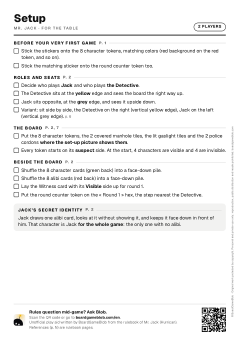 Setup
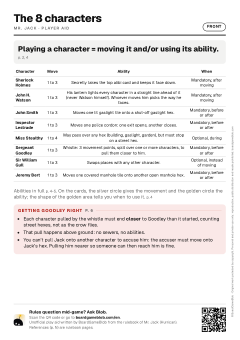 Player aid
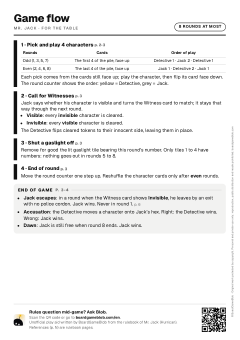 Game flow
The rules in questions
From the official rulebook by Hurrican. In parentheses: the rulebook’s page. How Blob answers
How does Jack win in Mr. Jack?
Jack wins in three ways: by escaping through an exit without a police cordon while the Witness card shows Invisible, when the Detective accuses the wrong character, or by staying free until the eighth round ends. (p. 3-4)
How does the Detective arrest Jack?
The Detective must move a character onto the hex where Jack stands and accuse him. A correct accusation wins the game for the Detective, but a wrong one hands victory straight to Jack. (p. 4)
Who chooses characters first each round?
In odd rounds the Detective plays one character, Jack plays two, then the Detective plays the last. In even rounds the order flips: Jack starts and finishes, and the Detective plays the middle two. (p. 2)
When is a character visible?
A character is visible when standing next to a lit gaslight, lit by Watson's lantern, or on a hex adjacent to any other character, even in the dark. Otherwise the character is invisible. (p. 2, 4)
What happens during the call for witnesses?
Jack announces whether his character is visible. If visible, every invisible character is cleared; if invisible, every visible one is cleared. The Detective flips the cleared tokens to their innocent side without moving them. (p. 3)
Can Jack escape from the district during the first round?
No, Jack can never leave during round 1. He may only exit in a round that follows a call for witnesses where he was invisible, and the first call happens at the end of round 1. (p. 3, 6)
Does Watson's lantern light up Watson himself, and does it shine past buildings?
No to both. The lantern lights the characters in a straight line in front of Watson, never Watson himself, and obstacles such as buildings, gardens and shut-off gaslights block the beam. (p. 4-5)
If I play Jack, why would I ever use Sherlock Holmes?
Because the alibi card you draw stays hidden from the Detective. That character can then only be cleared through deduction, which slows the investigation down. (p. 6)
Can I use Goodley's whistle to pull Jack onto another character and accuse him?
No. An accusation always requires moving a character onto Jack's hex, not the other way round. You may still whistle the suspect closer so that another character can reach and accuse him afterwards. (p. 6)
Can a character end its move where it started or on an occupied hex?
No. A character that is used must move at least one hex and finish somewhere new. Characters can pass through occupied hexes, but only the Detective may stop on one, to make an accusation. (p. 5)
Common mistakes
- Thinking Watson's lantern lights WatsonThe lantern lights characters in a straight line ahead of him until an obstacle, but Watson himself stays unlit. (p. 4-5)
- Forgetting neighbours see each other in the darkTwo characters on adjacent hexes are both visible, even far from any lit gaslight. (p. 2)
- Accusing by moving Jack onto someoneAn accusation always means moving onto Jack's hex, never bringing Jack to another character, even with Goodley's whistle. (p. 6)
What’s in the rulebook
See the other part
Tap a part and Blob explains it.
Expansions
The game
- Players
- 2
- Length
- 30 min
- Age
- 9+
- Released
- 2006
- Designer
- Bruno Cathala
- Publisher
- Hurrican
- Expansions
- 2
- Rules
- Official rulebook